

Demand generation often starts with a campaign idea: an asset, an event, a media plan. But for enterprise technology partnerships, the more important question comes earlier: Which accounts should we pursue together, and why?
A target account heat map answers this fundamental question and provides the foundation for a joint account-based marketing (ABM) strategy. It enables the operating discipline to focus partner investment on the accounts with the strongest combination of fit, need, timing, and relationship potential. It helps marketing and sales move from broad market coverage to coordinated action against a defined set of opportunities.
The need for that discipline grows as more partners enter the picture. In a multi-partner program, each company brings its own customer base, account priorities, data, sales relationships, and definition of opportunity. Without a common account framework, the program can quickly fragment. Partners pursue different targets, campaign funds are spread too thin, and sales teams struggle to understand where joint activity should begin.
ABM creates a shared center of gravity. It gives the program sponsor and participating partners a consistent way to identify opportunities while still allowing each partner to act on the accounts most relevant to its business.
A comprehensive target account heat map is the secret to successful multi-partner alignment.
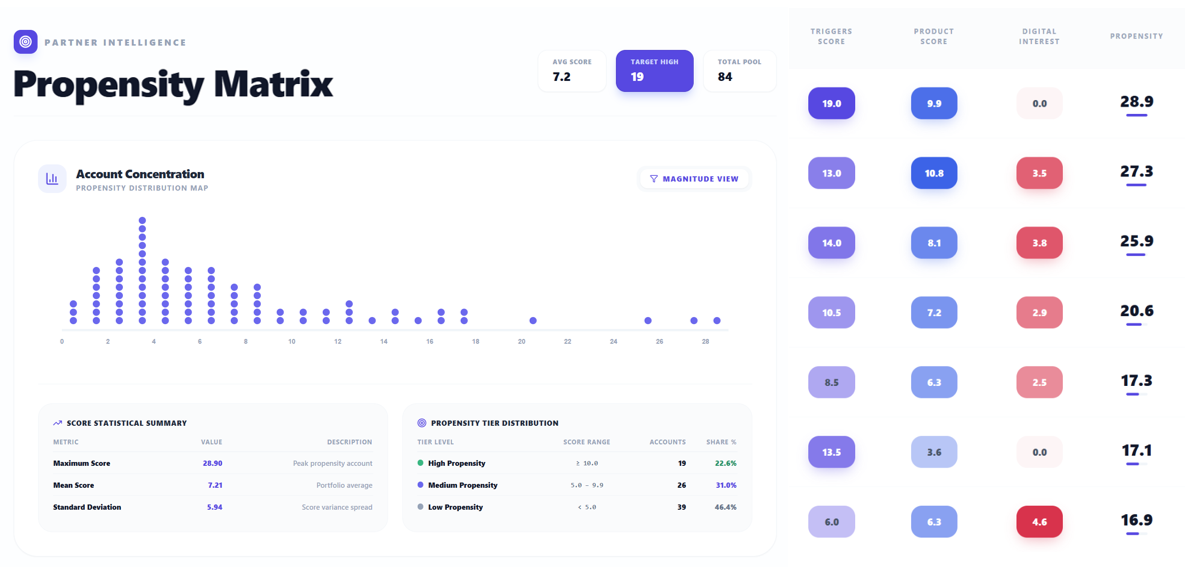
A target account heat map is a prioritized list of companies scored to indicate their relative value for sales and marketing outreach. In a partner program, the output should work at two levels: a cross-partner view for the program owner and partner-specific views that protect data separation and support execution.
This matters because alignment is rarely created by a kickoff meeting alone. It is created when teams can see the same account logic, understand why one company ranks above another, and agree on what action follows.
A well-designed heat map helps answer practical GTM questions. Where do a vendor’s installed base and a partner’s relationships overlap? Which customers are approaching a renewal or missing a relevant product integration? Which accounts fit the priority segment and are also showing increased interest in relevant topics? Which opportunities are best suited for expansion, and which require a net-new motion?
With those insights, marketers can build more relevant campaigns, leadership can clarify partner roles, and sales teams can focus their outreach. The heat map does not replace seller judgment. It gives sellers and marketers a more credible, mature starting point that makes joint pipeline planning specific rather than aspirational.
How it works
At Bridge Partners, our methodology begins with the sales motion, not the data. We first define whether the program is designed for account expansion, net-new acquisition, or separate models for both. We then establish the eligible account universe, including the inclusion and suppression rules that determine which companies can be scored.
Next, we inventory and assess the available signals. These may include vendor and partner account data, customer lifecycle information, firmographics, third-party intent, and technology-install data. Each potential dimension is evaluated for availability, reliability, relevance, recency, and coverage—not just thrown into the mix because the data exists.
We then design a transparent scoring framework with documented criteria, weights, priority tiers, partner-specific adjustments, and a clear rationale for each component. The data is normalized, matched, deduplicated, and reviewed for parent-child relationships and missing-data rules.
Finally, the model must be operationalized. That means consistent partner workbooks and dashboards, a program-level roll-up, quality assurance, methodology documentation, stakeholder materials, and a defined refresh process.
Throughout this process, we never lose sight of the goal: to create a shared, defensible view of where the partnership should place its next dollar, next campaign, and next sales conversation. It starts with a comprehensive target account heat map, the foundation for an effective, coordinated joint GTM.