

Earlier this year, I wrote about expertise in motion, the idea that companies pull ahead when expertise is embedded directly into how they operate. Value and scale come from applying expertise continuously, not delivering it once and handing it off.
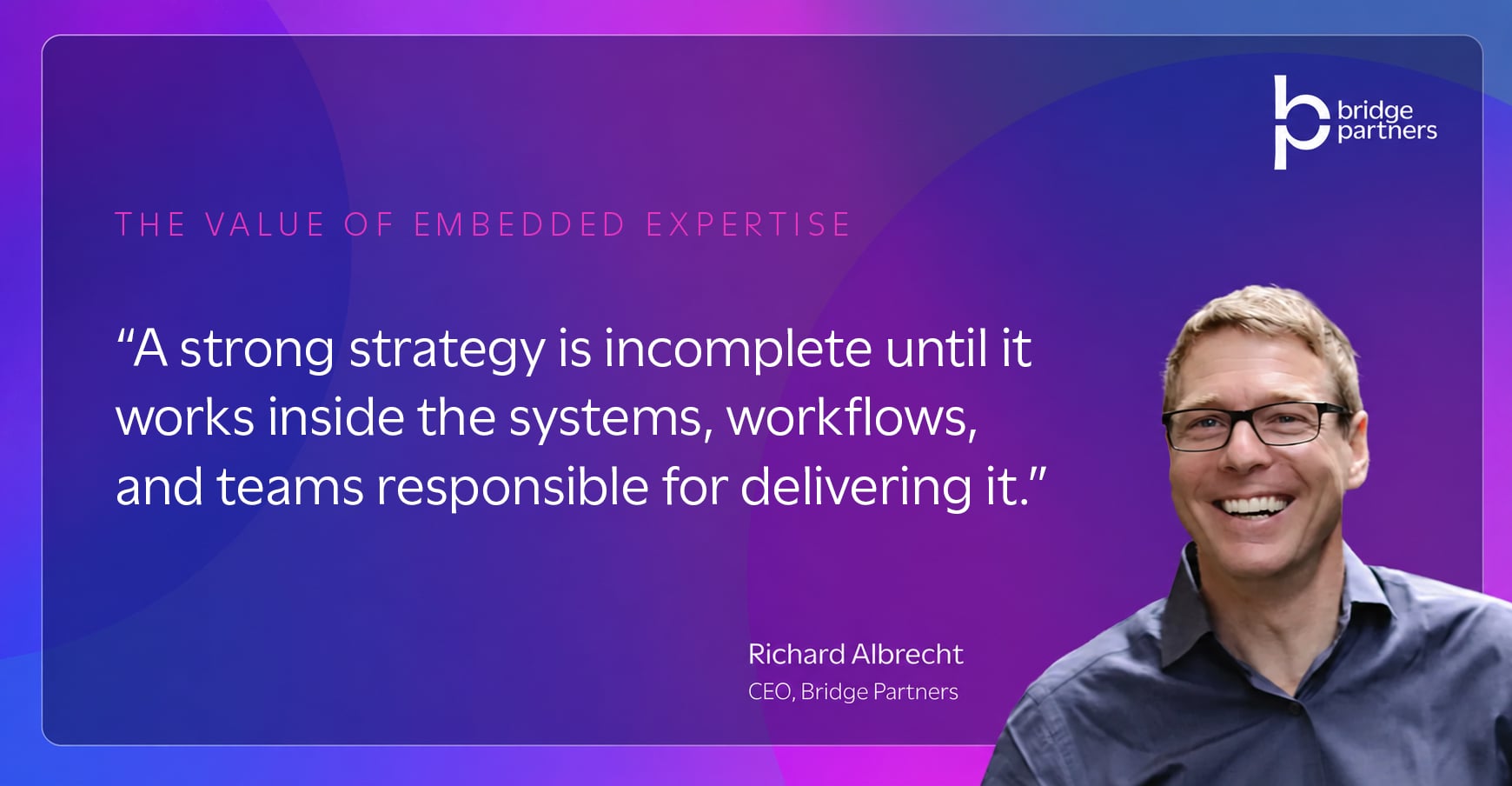
At Bridge Partners, that idea shapes what we’ve built. We’re growth engineers, bringing together business strategy, technical capability, and execution at scale to help our customers grow. A strong strategy is incomplete until it works inside the systems, workflows, and teams responsible for delivering it.
From executing tactics to building systems that scale
Our customers have launches to deliver, initiatives to execute, partners to activate, and revenue goals to hit. I believe this next chapter of consulting is about building systems that scale, enabling growth that doesn’t depend on adding more people and manual work at every step. They need progress they can see—not another set of recommendations waiting for a separate team to interpret.
At Bridge Partners, we’ve built technical capability into our marketing and partner work to do exactly that: connect systems, build repeatable workflows, and make AI persistent and effective in day-to-day execution. We want each engagement to deliver today while building something our customers can keep using, improving, and scaling.
When done successfully, the question isn’t just, “What did we get done?” It’s, “What did we build that makes the next launch, campaign, or program easier?”
That’s our job as growth engineers.
From handoffs to embedded execution
We’ve designed our forward-deployed engineering capability around that reality. Our goal is to combine the chops and strategic perspective of the leading growth consultancy with the technical acumen of an innovative engineering partner.
A growth engineer needs more than technical skills. They need the business judgment to understand a customer’s challenges and priorities and translate them into a working solution. Working alongside the customer’s team lets them test assumptions, learn through execution, and build around the conditions that actually exist.
For our customers, that means less distance between a business problem and the people who can help solve it. It also means fewer, simpler handoffs between the strategy and the work required to make it real.
Connecting the pieces that drive growth
Marketing and partner organizations are a natural fit for our approach. Their work brings together strategy, technology, content, data, and execution. A product launch, partner program, or sales motion can stall when the individual pieces aren’t well connected. Managing those complexities conventionally takes time, and quality often suffers.
Our growth engineering approach automates those connections. We link product capabilities to customer value, partner strategy to activation, and AI tools to measurable outcomes.
The goal is to build a more connected and scalable way of working—and to keep improving. Success means adoption, stronger capabilities, and business impact across the enterprise. That’s what growth engineering means to us: human judgment, technical capability, and customer context, deployed quickly and securely to help our customers grow and transform. I’m excited about what our team has built—and the growth we’re driving for our customers.