

I've spent the better part of my career working at the frontier of B2B go-to-market across industries, company sizes, and growth stages. The leaders I work with aren't behind. They're ahead. Running sophisticated teams, making serious bets, and operating in some of the most complex and fast-moving markets in tech.
And if there's one thing that work has taught me, it's how to recognize a pattern when it's forming.
Right now, I'm watching one take shape in real time.
The leaders I'm closest to are already moving on AI. Adoption isn't the question. The question is how to turn real momentum into durable, scaled impact and how to build the system underneath that can hold it together as the pace accelerates.
That's the hard part. Not because these teams lack vision or capability. But because they're building at the frontier: where the path isn't fully marked, the tools are still maturing, and the pressure to show impact is immediate even when the model is still forming.
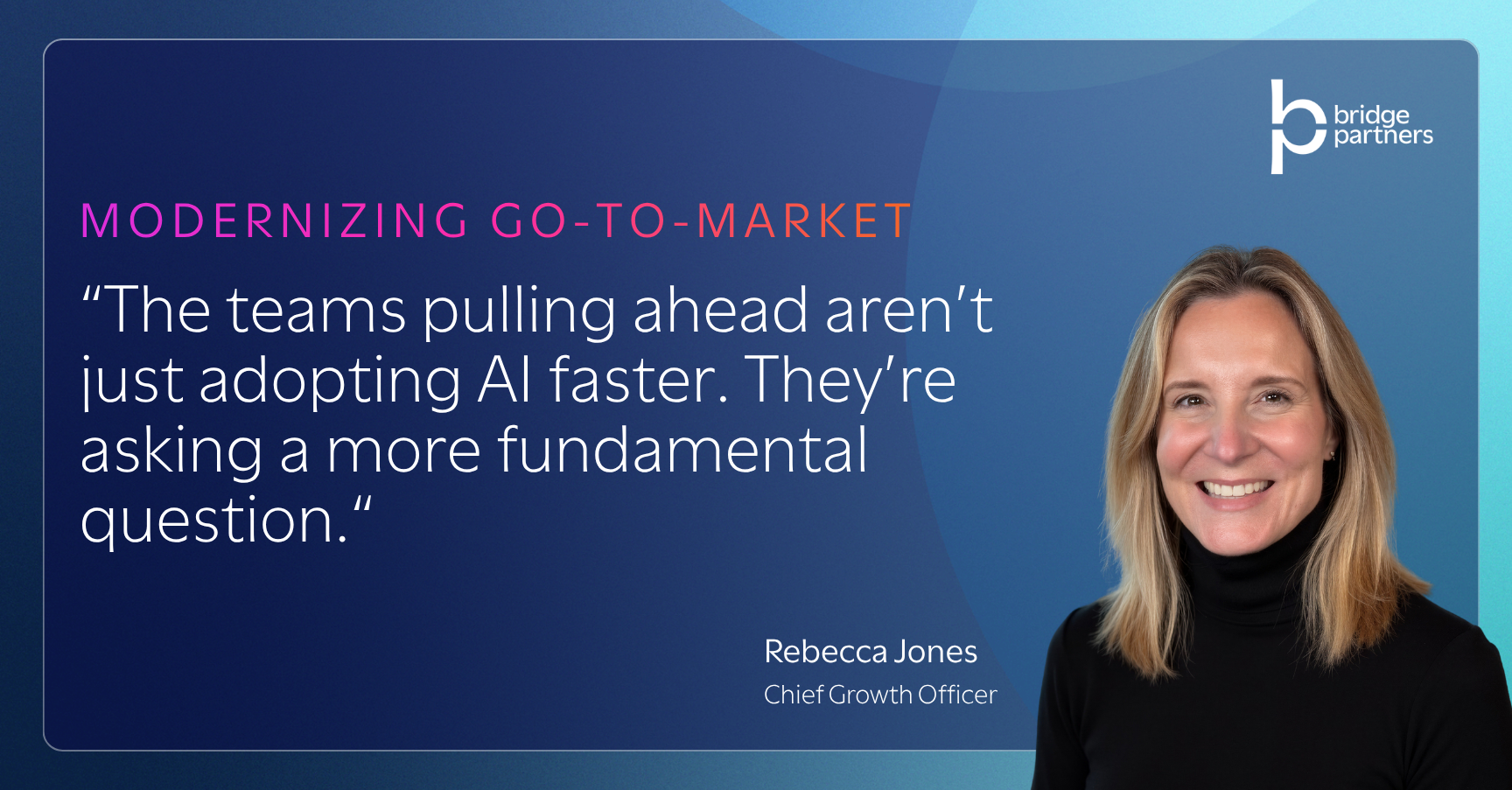
What I keep seeing across the best teams in B2B tech is that the ones pulling furthest ahead aren't just adopting AI faster. They're asking a more fundamental question: where should we apply AI and how should the entire system work differently with AI built in?
That question is what Frontier Marketing was built to answer.
Symptom vs. System
Marketing, sales, and partner teams are all doing the right things. But rarely in a way that feels cohesive to the buyer.
Campaigns launch. Partners activate. Sales engages.
There are a couple of stats I keep coming back to that are both heavy and dense: 86% of B2B purchases stall during the buying process (Forrester). And it's no wonder: complex purchases are slowing down because the average B2B deal involves seven partners across 28 buying moments (Omdia), not to mention the internal stakeholders in the buying committee. That's not a messaging problem or a demand problem. It's an orchestration problem. The system underneath the work was never designed to connect or scale it.
What We're Building
After 18 months of working through this opportunity with clients, testing what moves the needle, and watching where the real performance gains show up, we're launching Frontier Marketing: designed for product, partner, and marketing leaders within large enterprises.
Frontier Marketing is an operating model and a system that connects product, demand, and partner execution into one coordinated approach to growth, with AI embedded directly into how the work happens.
In practice, you see this in tangible ways:
- Campaigns connect directly to demand
- Content is built to scale, designed for personalization, reuse, and continuous adaptation
- Partner motions are integrated from the start, not bolted on later
- Execution is aligned to revenue outcomes
Where we've seen this come together, the results are real: faster pipeline movement, better deal progression, and meaningful efficiency gains without simply adding more people. These aren't projections. These are outcomes our clients have achieved in the last year.
Where We Started: Content and Campaigns
When we began designing Frontier Marketing with clients, we didn't try to tackle everything at once. We started where the pain was most immediate, and investment was already the highest. Forrester and Gartner state the average B2B company invests ~8% of annual revenue in marketing, and a large component of that budget is spent on demand, campaigns, and enablement content.
For most B2B companies, that's content. At every stage of a buying journey that keeps getting longer and more complex, content volume and velocity are critical to the successful engagement of customers and partners. And yet, it's where teams are most stretched, where waste is most visible, and where a better system pays off fastest.
So the first thing we built was a Content and Campaign Engine: a way of designing content and campaigns as a connected system, rather than a series of one-off efforts. AI is embedded directly into how content is created, adapted, and activated at scale.
The results have been meaningful for our clients. They’ve realized:
2–4x faster time-to-market, 30–50% reductions in production costs, and 3–5x increases in content output and variation with more consistent activation across partner ecosystems.
The Content and Campaigns Engine architecture is designed to produce structured, high-quality marketing outputs: from campaign plans, messaging frameworks, full content packages, performance projections, and execution-ready assets. The workflows are designed for marketing and partner leaders serving large partner ecosystems—GSIs, SIs, MSPs, Distributors, Service Partners, and ISVs—enabling them to launch campaigns faster without sacrificing quality, with more precision and greater measurable impact.
Extending the Model: Product GTM and Launch
We're seeing the same opportunity in product launches.
Most launches today are still treated as one-time events. Big push, lots of activity, then it fades. Teams are stretched across workstreams, alignment is inconsistent, and the connection to pipeline and revenue is often unclear.
The best teams are rethinking this by building launches that don't pivot on a date but an architecture that can sustain momentum and drive customer adoption. They’re defining clear lifecycle and journey design, consistent positioning and storytelling across teams, and AI-enabled workflows that keep execution coordinated over time.
The goal isn't just a better launch. It's turning each release into a sustained growth driver, one that continues to enrich customer experiences, feed demand, enable sales, and activate partners long after the announcement.
What This Means for Leaders
At the end of the day, growth isn't going to be driven by better campaigns or bigger launches in isolation anymore. It's going to be driven by how well the system behind them is designed and connected.
The gap between teams experimenting with AI and teams genuinely transforming how they grow is underway, and it's going to widen faster than most people expect. The difference, from where I sit, isn't just access to tools. It's whether leaders are willing to rethink how the whole system works.
That takes a particular kind of leader. One who sees this moment not as a problem to manage, but as an opportunity to build something that lasts. One who is ready to drive the change.
If that's you, let's talk.
This is the work I care most about right now: helping leaders bridge vision and execution, and building go-to-market systems that are durable and built for what's ahead.
We're just getting started, and the timing has never been better.