

Earlier this year, I wrote about what I called expertise in motion—the idea that the companies pulling ahead in 2026 aren't the ones with the most ambitious strategies, but the ones who've embedded expertise directly into how they operate, continuously, in real time.
More than two decades working alongside technology leaders through major industry transitions has taught me to recognize when the underlying rules change. Not the surface-level change, where new tools replace old ones. The deeper kind, where entire operating models must change.
We're in one of those moments.
The Inflection Point Most Teams Are Missing
Every major platform shift has the same pattern. The transition from on-premise to cloud didn't reward the companies that migrated fastest. It rewarded the companies that rebuilt their go-to-market around what the cloud actually made possible. The tools mattered. But the operating model mattered more.
AI is at that same point now. Most organizations have access to a robust AI toolset. What separates the teams pulling ahead is how effectively those tools are connected to workflows, execution, and revenue outcomes. When those connections are missing, AI creates isolated efficiency. When they're coordinated well, it compounds value across an entire organization.
The companies that get this right in the next 18 months will be difficult to catch. Not because of the tools they're using, but because of the expertise embedded in the system underneath.
What We Built and Why
That's the thinking behind our Frontier Marketing Engine, a connected suite of agentic AI tools that revolutionizes enterprise marketing workflows. We’ve built an expertise-driven operating model and a connected set of tools where product, demand, and marketing execution work in a coordinated system. With Frontier Marketing, our expertise and AI-driven continuous improvement are embedded into the work itself.
The results clients have seen reflect what happens when the system is redesigned intentionally: faster time-to-market, lower production overhead, and stronger execution across complex go-to-market motions. But the larger opportunity is what follows — launches, demand generation, sales activation, and customer engagement operating as connected parts of one system rather than competing initiatives.
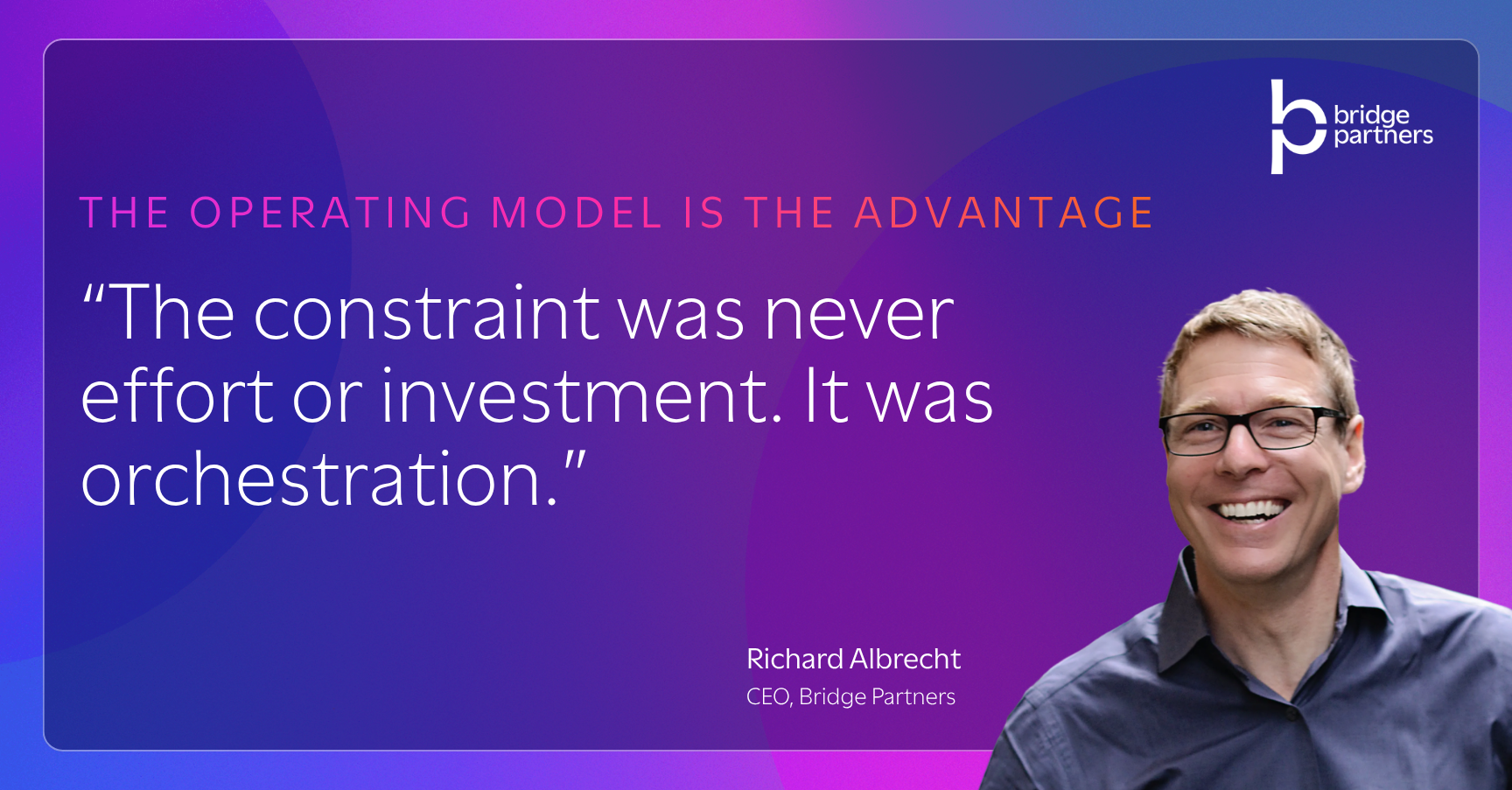
The constraint was never effort or investment. It was orchestration.
The Operating Model is the Advantage
Earlier this year, I described three traits shared by organizations succeeding through this kind of transition: operating in systems rather than silos, designing for adaptability rather than deliverables, and embedding expertise rather than extracting it.
Our Frontier Marketing solution was built on those criteria. And the leaders I see moving fastest share one thing in common: they've stopped treating go-to-market as a series of coordinated efforts and started treating it as a system with compounding returns.
That shift requires rethinking how teams operate together, how execution connects across functions, and how AI becomes genuinely integrated rather than simply adopted. The organizations doing that work now are building something difficult to replicate. Not because the components are proprietary, but because a well-designed system, once running, creates its own momentum.
That’s what expertise in motion looks like in practice. And I believe it will define the next generation of growth.